
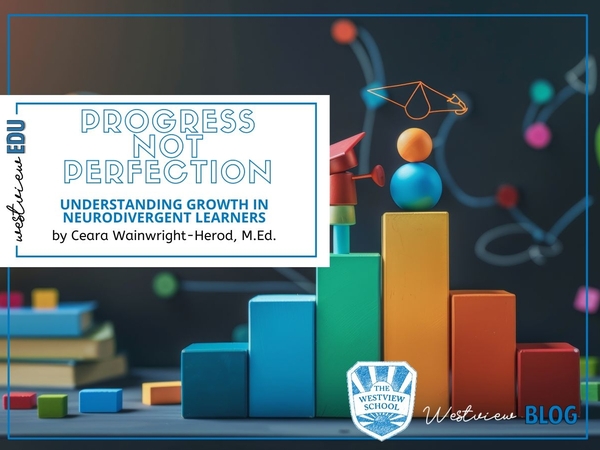
Progress, Not Perfection: Understanding Growth in Neurodivergent Learners
December 05, 2025
When Ceara Wainright-Herod, Upper School Principal at The Westview School, addressed parents at a recent Westview EDU, she began with a simple question: What does progress really mean?
The answer, she suggested, has little to do with report cards. With nearly two decades of public education experience, Herod has worked with students across the autism spectrum, neurodivergent and neurotypical learners alike. One message, she says, has remained constant: growth differs for every child and rarely follows a straight line. Her Westview EDU session, "Progress, Not Perfection: Understanding Growth in Neurodivergent Learners," directly challenged the common belief that progress is only about grades, reinforcing that growth at Westview is about the whole child.
Beyond the Report Card
“Dictionary.com defines progress as growth and development, continuous improvement, a movement toward a goal,” Herod said. “Nowhere in that definition do you see the word ‘grades.’ Nowhere does it say ‘academics.’”
For many parents, grades carry enormous weight. A low test score can cause worry; a good report card offers reassurance. Herod believes equating grades with progress overlooks how children, especially neurodivergent ones, develop.
“There are so many skills your child is building that don’t show up on a report card,” she said. “Independence. Confidence. Curiosity. Emotional regulation. Problem-solving. Those are real gains. They deserve celebration.”
The Myth of the Straight Line
One important part of Herod’s message was the reminder that no child grows in a straight, predictable trajectory.
“Growth includes plateaus, regressions, and spurts,” she said. “That’s not a flaw, that’s development.”
She encouraged parents to recall their own school years: subjects that came naturally, years that were a struggle, moments when understanding clicked. Children experience the same uneven progression. Neurodivergent learners may show this more, but the pattern is universal.
“A single low grade isn’t the story,” she said. “It’s one data point in a much bigger picture.”
Three Lenses for Understanding Growth
Westview uses a holistic, strength-based model to understand student growth, which Herod believes offers a more accurate and compassionate view. The model includes three domains:
ACADEMIC GROWTH: This includes the traditional markers such as reading, writing, and math, as well as the quieter signs of learning: beginning an assignment independently, asking questions, showing persistence, and building comprehension over time.
“Academic growth isn’t just the score,” Herod said. “It’s effort, curiosity, and the willingness to try again.”
SOCIAL-EMOTIONAL GROWTH: This area encompasses emotional regulation, self-awareness, confidence, and peer relationships. For many neurodivergent learners, these skills take time to develop.
“When children don’t know something, we teach,” Herod emphasized. “That includes how to deal with frustration, how to express emotions, and how to calm their bodies and minds. These are learned skills.”
EXECUTIVE FUNCTIONING: Organizing materials, managing transitions, following routines, and using coping tools are key here.
Herod recalled watching Westview Middle School students confidently open their lockers this morning, something that had taken weeks of practice and patient guidance.
“It was incredible to witness,” she said. “Routine, structure, and repetition work. When students succeed, their pride is enormous.”
The Role of Discomfort in Growth
Herod repeatedly emphasized: growth is uncomfortable for children and adults.
She shared several quotes with the audience, including Brian Tracy’s well-known line, “Growth and comfort do not coexist.”
She explained that children resist new challenges not because they can't succeed, but because the discomfort can be overwhelming.
“Those big reactions you see? The protests, the tears? That’s fear,” she said. “They don’t yet have the words to say, ‘This scares me’ or ‘This is hard for me.’”
Parents can help their children manage discomfort by modeling coping strategies.
“Tell your kids, ‘I’m nervous about a meeting today, so I’m taking deep breaths,’” she suggested. “Show them what managing big feelings looks like. That vulnerability is powerful.”
Rethinking Assessment
Twice a year, Westview uses standardized MAP Growth assessments to gather academic data, but Herod urged parents not to put too much weight on the scores.
“These tests aren’t designed specifically for neurodivergent learners,” she explained. “Some students sit through 45 questions in one session. If they’ve had a tough morning, if they’re distracted, if they’re overwhelmed, that score isn’t representative of their true understanding.”
Instead, the school emphasizes teacher observations, student reflections, and classroom work samples for a complete picture of progress.
“Tests matter,” she said, “but they don’t define your child.”
A Partnership Between Home and School
Herod stressed the importance of partnership: parents know their children best, and teachers see them in structured settings. Together, families and educators provide continuity that helps students thrive.
She encouraged parents to share what works at home, ask questions during conferences, and communicate openly with teachers about concerns.
"We are a village," she said. “Your insight helps us support your child, and ours helps you support them at home. Working together, students make meaningful progress.”
A Final Story
Herod ended with a personal story. At four, she struggled with separation, sensory overwhelm, and fear, crying daily at her first school as staff grew frustrated.
“I wasn’t dramatic. I wasn’t a troublemaker. I was anxious,” she said. Her mother moved her to another school where she felt safe and welcomed. She never cried again.
"I share that to show what safety and belonging can do for a child," she said. “That's what we want for your children at Westview: a place where they feel loved, supported, and celebrated on all days.”
The Message Parents Took Home
By the end of the session, one message stood out: progress is not about achieving perfection, but about each child's unique, steady growth at their own pace.
“Your children are not victims of their challenges,” Herod said. “They are victors. And every day, we see their victories.”
--
Ceara Wainwright-Herod, M.Ed. is the Upper School Principal at The Westview School. She has over 18 years of experience in public education, having served as a teacher, specialist, and assistant principal in public school system. Her work is grounded in student-centered learning and inclusive leadership. Ceara holds a master’s in Educational Leadership from the University of Houston–Victoria and has extensive experience supporting students across the autism spectrum and has collaborated with families and specialists to design individualized plans that meet each learner’s needs.
This blog post was adapted from the presentation given during WestviewEDU on Thursday, November 13, 2025. WestviewEDU is an education series presented by The Westview School for parents and caregivers of children with autism. For a complete list of WestviewEDU sessions remaining for the 2025-2026 academic calendar year, visit The Westview School online.