

The Westview School Blog
Archives - April 2021
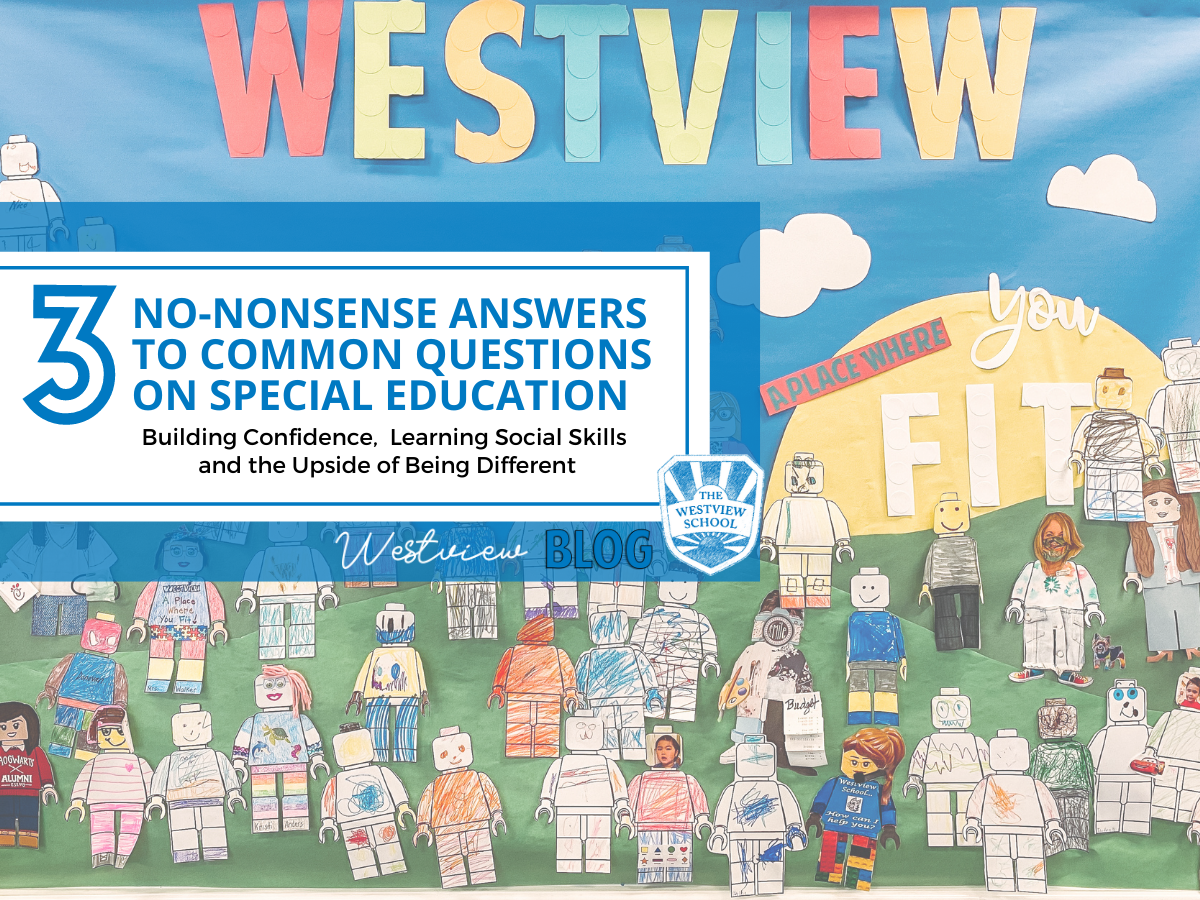
3 No-Nonsense Answers to Common Questions on Special Education
April 29, 2021
Did you know that tigers have striped skin and not just striped fur?
Did you know that reticulated pythons are longer than green anacondas?
Did you know the formula for the volume of spheres is four-thirds times Pi times radius cubed?
Did you know that honey is actually just bee vomit?
There is a common saying within the autism community, "If you've met one child with autism, you've met one child with autism." Facts and insight collected from various students across various grade levels prove the point that we can always learn something from someone else. Like the students at The Westview School, these little nuggets of information are as different and varied as those who shared them.
With enrollment season upon us, the admissions department of The Westview School is busy fielding questions about the benefits of a private special needs education. Families are looking for the best fit for their children. The Westview School is proud to offer children on the autism spectrum a unique, specialized learning environment with outstanding educational and social opportunities. Some of the obvious benefits of a specialized special needs school include small classroom sizes and curriculum and instruction that is adapted based on each student's need. But there is much more that a school like Westview can provide a child that is not so easily quantified.
We asked our in-house experts, Becky Mattis, M.Ed., Admissions Director for The Westview School, and Mimi Le, M.A., LMFT, LPC, one of Westview’s Student and Staff Support Specialists, to weigh in on commonly asked questions prospective families have when deciding on a program like The Westview School. Their no-nonsense answers to the top three prospective family concerns about a private specialized education are supported by frank, heartfelt, and honest feedback from Westview students in elementary and middle school.
QUESTION 1: Will my child develop self-confidence?
One thing a parent of a child with autism learns very early on is that brains can grow. Developmental pediatricians and neurologists will tell parents, early intervention is the key, that a child's potential cannot be determined until they have an opportunity to learn. Children on the autism spectrum who participate in early intervention therapies and specialized schooling from an early age develop a growth mindset. The concept of a growth mindset was originally taught by Stanford Professor, Carol Dweck. She asserts that facing challenges, working hard, and learning from mistakes develops persistence and results in growth in intelligence and abilities. She further theorizes that people who develop a growth mindset at a young age are confident, resilient, and have a passion for learning. At The Westview School, you will frequently hear a teacher encouraging a student who is struggling with something say, "That's okay, you can try again." Instead of becoming frustrated when they make a mistake, we want our students to quickly regroup and try again.
Becky Mattis: Parents worry about self-esteem for their special needs child. The self-esteem impact that kids have when they are in a place that is meeting their needs, and they are learning and being successful is vastly greater than the negative impact that being in a place where their needs are not met, and they are feeling different and singled out.
Mimi Le: There is a vulnerability [at Westview] that you do not get in a neurotypical school setting. The vulnerability is that I am not the best at this. How can I get better? Both peers and teachers work together to help and encourage you. This may still happen in a neurotypical setting, but at Westview, we are very aware of it, and we make it part of each day, and so do our students.
When a student feels like they can excel at something new, they feel supported in their effort, and in turn, the other students in their class help that too. Students want to learn from the kid that is the expert on trains or the best at math. At Westview, there is never the social expectation to fit into the typical school social norms. There is no judgment. This builds confidence in a child when they are around others that support their expertise in something.
We asked Westview students, “What is your favorite thing about The Westview School?”
Jaden, Middle School: The teachers will go completely out of their way, will do anything they can to see their students succeed. They are always so nice and supportive, and I could not have any better teachers.
Thibault, Upper Elementary: I like this place because it provides a safe place. A safe place from bullies. [Westview] gives me a safe place to learn, and it achieves all its goals in doing so with all its students.
Noah, Middle School: I think The Westview School is a great place to be. The teachers, the classrooms, the fun things we get to do.
Cason, Middle School: My favorite things about The Westview School are the people, the academics. Look around [gesturing down the hallway]; this place looks pretty good.
Ruby, Lower Elementary: My teachers and everybody loves me and PE.
Theo, Lower Elementary: I have lots of friends to play with, and I learn things that I never knew before, and just like Ruby said, I like PE.
QUESTION 2: How will my child learn appropriate social skills without typical peer role models?
Becky Mattis: It is a common question for prospective parents, "Why not just put our child in a mainstream school to learn and observe social skills?" If our children could naturally pick up social and classroom skills from their neurotypical peers, they would easily fit into a mainstream setting. At The Westview School, we get excited when our kids pick up other behaviors because we can then use that as a building block for teaching and guiding our students toward a more appropriate social interaction. By virtue of the population, most of our students struggle with social skills, and because of that, we are intentional in working on the development of social skills throughout the day. The child is not being singled out by being pulled away to talk through those social situations. It is a learning experience for the whole class.
Mimi Le: When children on the autism spectrum are with others who are like them, they are more accepting of individuals with differences. When we put students together in a group or a class, we are looking at where are they are going to fit socially, behaviorally, and academically, so that they can learn something from another student. Where one student may be best at a particular thing, another student can learn from them. Everyone is learning from each other in those three different categories, which helps make them more well-rounded. All kids are different, autism or not. There is always something you can learn from someone else. The thought Westview puts in to placing our students helps to build a respect and appreciation for each other that they would not get in a normal neurotypical setting.
We asked Westview students, “What is something that your friends like about you? What makes you a good friend?
Jaden, Middle School: I am very persistent, and I will do what I can even if it must sacrifice quite a lot to get done what I need to do. I think that me knowing a lot makes me special because I get to teach people what I know, and I find teaching very fun.
Thibault, Upper Elementary: I am passionate, and I strive to work hard almost every single day. I am determined.
Theo, Lower Elementary: I like to run around and exercise a lot and play games. I like to play games on the playground besides tag, because my best friend Sid doesn’t like tag. I like it, but I want to play with him.
QUESTION 3: What if my child knows they are different?
We are all different, and differences should be celebrated, and all children should be taught in a way that most benefits them. In October of 2020, a teacher’s online post on why her neurotypical classroom looks like a special education one went viral. Karen Blacher, who has two children on the autism spectrum herself, found that students benefit greatly when classroom strategies are more focused on encouraging students to openly communicate, and expectations are adapted specifically to that child. Students are taught to both self-advocate and self-regulate.
Becky Mattis: We recognize that all kids are different whether they are on the spectrum or not. Each of our Westview children will discover the ways they learn best and how to then advocate for themselves. Self-advocacy is not only a skill they need for school but in life as well. Being accepting of the things that challenge them.
Mimi Le: Our kids become comfortable with who they are. It is okay to be different. Our kids develop an appreciation for themselves and each other. They are learning that their differences can be something they are proud of, and we foster that in the classrooms and through our conversations with parents. Our students will continue to give the world a new perspective on every aspect of life, and this new lens will lead to breakthroughs in the future.
With cultivating confidence in mind, we asked several Westview students, “What makes you special?”
Cason, Middle School: To be honest, I think I am pretty smart and good at gaming. I am probably the smartest in math. My brain works a little differently than everyone else. It can be good or bad in different ways.
Satvik, Middle School: I am a very tall person, and I am a hardworking boy.
Thibault, Upper Elementary: What makes me special is that I am different from everyone else, and it is like a whole different experience. Without these differences, I wouldn't have gone to Westview in the first place, and my sisters love me literally for who I am.
The Westview School’s mission is to provide a unique, specialized learning environment offering outstanding educational and social opportunities for children on the autism spectrum. We believe that children with autism spectrum disorder can grow and learn through a nurturing, positive, and happy environment that enhances their self-esteem. Building confidence, learning social skills and celebrating our differences is something that The Westview School builds into our daily curriculum.
If you think The Westview School could be a fit for your child, join us for our next Informational Session. The event includes discussions with our Admissions Director, Becky Mattis, about the student experience and program deliverables. Current parents will also be present to offer perspective and answer questions.
The Kids Are Alright: Words of Wisdom from Special Needs Siblings
April 15, 2021
It has been said that you spend more time with your siblings than anyone else. It is one of the most formative and longest-lasting relationships a person will have. It is estimated that by age 11, siblings have spent more than 33% of their spare time together. When one of those siblings is on the autism spectrum, it is possible that the amount of time together may not differ, but the sibling dynamics certainly could.
Big sisters become little mothers. Big brothers become protectors. Younger siblings learn to be helpers. When a sibling is diagnosed on the autism spectrum, older and younger siblings tag along to therapy appointments and commutes to special schools. They become aware of differences between themselves and their siblings very early on. However, the differences and awareness that come from having a special needs sibling can often positively influence both the neurotypical child and the child with special needs.
Despite the dynamic shift, when children on the autism spectrum have a sibling in the home, it has been shown to positively affect the special needs child. Neurotypical siblings can provide increased opportunities for social skills in the home and serve as role models to siblings with special needs.
But, what about the sibling without a disability? Having a brother or a sister with special needs, in a way, can be pretty similar to having a typically developing sibling. There are the expected challenges among siblings – bickering, rivalry, learning to share, but overall, siblings of children with a disability, including autism, have a great capacity to be highly empathetic, compassionate, tolerant, and responsive to the need of others.
The Westview School blog interviewed several Westview staffers who all arrived in a special education career after growing up with a sibling with special needs. We asked them to share their experiences, how it shaped them as adults, and advice on the positive impact having a sibling with specials needs has had on their life and career in special education. We hope that by sharing their stories of growing up with a special needs sibling, our families may see the positive influences a sibling with special needs can bring to your child’s life.
Caelyn Pho is a Pre-kindergarten teaching assistant at The Westview School. She is the oldest of seven siblings. Caelyn’s youngest sister, Meagan (13), was diagnosed on the autism spectrum at four years old.
“I was twelve when my sister was born,” said Caelyn. “She was not diagnosed early, so I do hold a little bit of guilt, especially since working here. I realized how much more she struggled because of the delay.”
“I come from a very traditional Vietnamese family. Our culture's instinct is to protect,” said Caelyn. “It was more challenging during her younger years before our family learned the skills and strategies to be able to properly deal with her tantrums or other challenges.”
Lexi Doré is a Kindergarten teaching assistant at The Westview School. She is the only sister among four brothers, three older brothers and one younger. The two brothers closest to Lexi’s age are twins, Dalton and Dylan (24), and were born with cerebral palsy. Lexi’s younger brother Bouxdie (11), affectionately called Boux, was diagnosed on the autism spectrum at two years old.
“We got a pretty concrete answer that Boux was on the spectrum when he was two. He wasn’t talking, and he had a lot of food sensitivity.” Lexi remembers the early years of speech therapy and occupational therapy.
Jared Dawkins is the Upper Elementary and Middle School science teacher at The Westview School. He is the middle child of three siblings. His younger brother, Jacob (20), was born with Down Syndrome.
Jared’s experience with special needs started years before his brother was born. “My dad had a cousin, Kevin, with Down Syndrome, so we were very familiar with it already,” Jared said. “From a young age, we were taught that Kevin was different, but he was still part of this family, and we should treat him the same as every other family member.” Jared learned about his brother’s diagnosis before Jacob’s birth. “My mom knew before Jacob was born, and I remember being told that he was going to be like Kevin,” said Jared.
How has having a sibling with special needs positively impacted your life?
Caelyn: I know that Meagan has influenced me and made me more empathetic and compassionate, and understanding to people who do have challenges. Because of my experience with Meagan, I never hesitate to reach out if I see somebody struggling. I never mind helping. Without judgment, there is just a simple, “Oh, you look like you need help.”
Lexi: I have always been an empathetic person with a big heart, but I think that all stems from my special needs siblings. As I’ve grown older, it has become more of a part of me, and it is something I pride myself on, being empathetic towards others. I know how it feels like to be different, and I try my best to accommodate people in how they want to be treated. Because of my experience, I pass that thinking on to my friends and everyone around me. They are just like everyone else.
Jared: Language is a huge issue for my brother, Jacob. He is twenty now, and his language is far less advanced than anyone he communicates with. Communicating with Jacob was learned through sibling dynamics. It comes second nature to our family. This ability to communicate is one skill that has served me well at Westview. Some of our kids seem unapproachable, but I find it very easy to get through to them and understand them.
How did growing up with a sibling with special needs lead you to a career in special education?
Caelyn: My sister is the absolute reason that I started working with this population. If it were not for her, I would not have found my passion, and I will be forever grateful to her. I feel bad for my friends who are miserable at their jobs, and I get to walk in every day, make a huge impact, and love it. That is all thanks to Meagan.
Lexi: I have always had a heart for people with special needs because of my older brothers, but especially when Boux came into my life. I was already volunteering at camps for children with CP. Knowing Boux and how beautiful his mind is and interacting with his classmates on field trips, I wanted to interact with more kids on the spectrum because they are so different, but they are all beautiful and unique. I just wanted to see life through their eyes, and being more hands-on with them is the best opportunity for that.
Jared: After finishing my undergrad degree in English Literature, I enrolled in Texas Teachers to earn my alternative teacher certification. One of the school counselors recommended special education “to boost my resume.” Westview was a perfect fit. I am still learning how to be a teacher, but one thing I didn’t have to learn how to do was learn how to approach and interact with our students. It can be challenging to find people who can interact with our kids in a meaningful and genuine way, and I had that experience already.
What advice would you give to siblings of children with special needs that you have learned from your family’s experience?
Caelyn: There was always a heightened sense of awareness that my sister was different when we were out in public. I was uncomfortable having an audience during an already stressful moment. As a young girl, this would make me angry when I noticed other people minding our business. As I have matured, I have learned to channel that negative energy into help and support for my family and sister. They are what matters.
Lexi: My best advice is, ‘Give yourself the love that you give to others.’ It is important to recognize that it is okay to focus on yourself sometimes, and I am learning this more and more as I get older. You don’t have to feel guilty for taking care of yourself and your needs. Help your sibling. Help your parents as much as you can but be patient with yourself and treat yourself like you treat your siblings.
Jared: It's essential to treat a special needs sibling as normal as possible. It is the only way I know how to interact with people with special needs, be patient and considerate of their particular needs, and treat them as typical as I can. For example, one thing I'll do is if we tell a joke in a family setting, my brother will ask what was said. His language may hinder him from fully understanding the joke in the same way, but just him receiving that information makes him feel like part of the group. In my experience, it's better for me, and my brother enjoys it more when we include him in the game.
What do you love the most about your siblings?
Caelyn: Spoken language can be challenging for Meagan, but she can sing a whole Frozen song without thinking about it. We are a very musically inclined family, so there is lots of singing and dancing for every family get-together, and Meagan is the star of the show. Meagan will start singing along, and she loves to dance. For this reason, she has become one of the pillars of our family just by being there. She reminds all of us to be in the moment. When we get together, we are all pulled in and connected.
Lexi: Boux wins over everyone that he meets. All my friends have this love for Boux. He is just the best person ever. He’s my best friend. Boux is one of the brightest, smartest, coolest people I know. Even though he is not able to convey through words that he loves me, the look on his face, when I walk into a room, I know that I am his best friend too. He teaches all of us that you don’t need words to express how much you love. Love goes beyond words.
Jared: His love for my dogs. I know Jacob loves me. He asks about me when I’m gone, and he likes to hang out with me. I do not doubt how much I mean to him, but my dogs mean more. We have a blast when I come over, and he will want to hang out with me, but if I show up without the dogs, his first question is, ‘where’s Sam?’ I am always second to the dogs.
The Westview School’s mission is to provide a unique, specialized learning environment offering outstanding educational and social opportunities for children on the autism spectrum. We believe that children with autism spectrum disorder can grow and learn through a nurturing, positive, and happy environment that enhances their self-esteem. This is attainable for our students because of the dedication of our faculty and staff. The Westview team is comprised of seventy members, each of whom was led to our special school for varying reasons with a similar underlying theme — a love and passion for the children on the autism spectrum and a willingness to make a difference in the life of a child. For Caelyn, Lexi and Jared, this experience is a bit more personal, and our school is better because we have them as part of our staff.
Reasons To Love Trains: A Mother's Journey with Autism
April 07, 2021
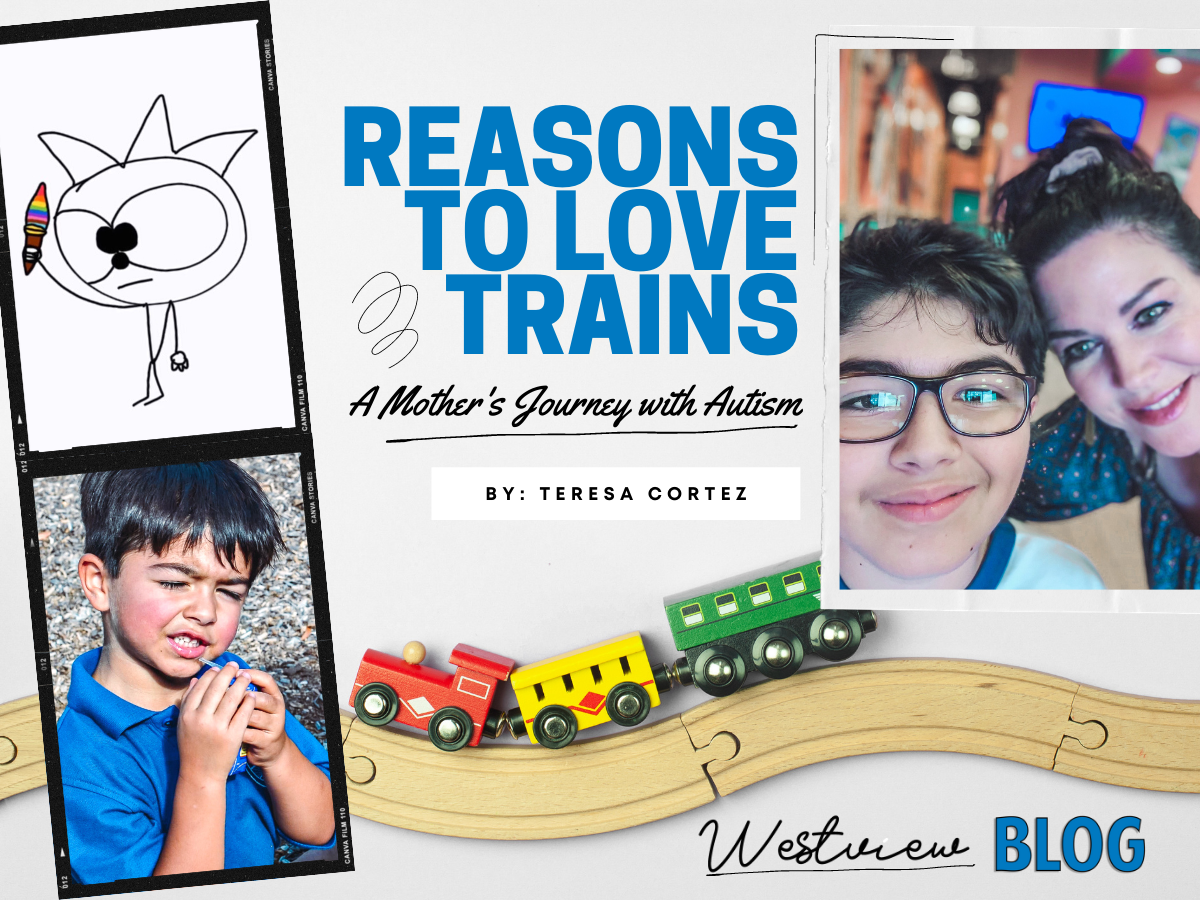
The behavioral therapist who assessed Julian in October 2010 spent two hours alone with him, took into account his developmental delays and inappropriate behaviors: the pushing, spitting, lack of engagement, and severe language delay; the crashing, breaking, food sensitivities, and meltdowns. Once I joined them, the therapist and I talked as Julian played with a vibrating train. He held the train by a thin string for twenty minutes, lifted the train up high, near the left side of his face, and moved only his eyes, shifted them hard left so he could stare at the bright red blur in his periphery. Perhaps he loved the leftward pulling sensation behind his eyes, the string vibrating in his small hand. Maybe it was the change in perspective as he held the train so close he was able to blur the separation between him and the shiny inanimate object.
Near the end of our session, the therapist smoothed the paper on her desk with one hand, looked at me, and said, “I believe Julian is moderately autistic.”
Her word choice struck me immediately. She hadn’t said “mildly” or “severely.” He wasn’t a little or a lot autistic. He was, according to Webster’s College Dictionary, “within reasonable limits…of average or medium quality.” Was there a reasonable level of disability?
“You do?” I asked because I’d hoped for anything but that, and in my denial, had become certain Julian only suffered from apraxia of speech. Now I needed a minute to recover enough to mask my devastation.
“I know this can’t be easy for you,” she said, and I lost my resolve not to cry.
At that moment, the Julian I knew – three years old, flirty, quirky, affectionate, in love with movies, cows, and alphabet letters – was gone. In his place stood a little boy from another planet, a familiar stranger. I’d just handed my former son over to a medical statistic, another 1 in 42 boys.
Almost overnight, a whole new existence formed, a parallel world that looked like earth but wasn’t. It was full of specialists with names like Toshio, Toodie, and Tempa, like Lion, Scarecrow, and Tin Man. It was a sudden ambush of therapies I’d never heard of, long drives, too many forms to fill out, and appointments every week.
I didn’t sleep much. I’d wake in a panic at 2 a.m. and tiptoe into his room to watch my newly foreign child sleep. Grief sometimes took an unusual turn. Though I didn’t notice right away, my husband and I had stopped making videos of Julian and his sister, Victoria. We were still learning what autism was, but we perceived it as a loss, as the erasure of a person we thought we knew well. In essence, this meant one of our children had died, and it felt wrong to record the empty space.
But Julian was very much present; it was his parents who were lost. Still, there was an amorphous loss. Julian wasn’t blind or missing a limb. There was simply no way to truly name or measure what was lost, to label precisely what we were learning to accept. No one could tell me where we’d be in twenty years, what to expect.
If I asked for his name, he told me his age. If I asked his age, he told me his name or launched into a slurred rendition of the alphabet song. At almost four years old, his longest self-composed sentences were two words; he knew about six of these short sentences. His enunciation was awful; therefore, I was one of only a few people who could understand him. He could ask for juice or a toy, but he couldn’t tell me when he was sick, sad, tired, or hurt. He couldn’t tell me he loved me. He couldn’t answer most questions. He didn’t understand words like What, When, Where, How, and especially, Why.
I read countless articles and books about autism, searching for any window into my child, for a cure if one existed. Where were we going with so many hours of therapy, and when would we get there? I asked doctors, teachers, and therapists ten million questions, and still, no one could explain what was lost and whether we’d find it again.
Autism was a social communication disorder with repetitive behaviors, but beyond this general description was a wait-and-see prognosis for every unique child. There was no way to predict what his future would look like. We would have to learn as we went along, accept the trial and error of various therapies, diets, and doctors. His brain was structured differently, not erased. So not only would we need to teach Julian differently, we had to relearn him.
Although he couldn’t use a spoon, hold a pencil, drink from a cup, sit still, or play with other children, I saw a spark, a hint of a brighter light that was, for now, obscured.
Would he ever read? Write? Sit still? Potty-train? Would he be able to work? Was independence the ultimate goal?
Julian had many challenges, but language was especially difficult. Even though his speech became clearer and he began to memorize entire movie scripts, he still struggled to compose his own sentences.
Then he began using movie lines to communicate with us effectively, but still, how could he achieve independence with “movie talk”?
In 2016, I heard about Owen Suskind, a young man with autism who used Disney animated movies to express complex emotions like love and loss. In both the book and documentary film, Life, Animated: A Story of Sidekicks, Heroes, and Autism, his father, Ron Suskind, explained his support of Owen’s Disney obsession by describing why he communicated with his son using puppets and silly character voices, encouraged Owen’s drawing of favorite characters, taught coping skills by applying lessons learned from Disney films to everyday life. He summed up his reasoning with a single sentence, “Whatever works to get to Owen.”
Whatever works to connect…
After learning about Owen, I threw everything I had at Julian’s obsession with movies. I bought the DVDs as soon as they were released, and the small character figurines. I allowed extra time on his iPad, let him watch movies in the car. Soon not only did he tolerate holding a pencil, but he also showed an interest in drawing. So I gave him colorful pencils, crayons, reams and reams of paper. Soon it was evident that he loved drawing, and I noticed that no matter how crudely drawn his characters were, their facial expressions were clearly nuanced. By watching the same movies over and over, he’d taught himself to draw feelings, and all he couldn’t capture in words.
He drew family members and school friends and always included himself as a central character, a protagonist in every adventure. He clearly expressed feelings, motivations, and even abstract thought in pictures. He drew complicated family dynamics, like the day he was born, and inadvertently “replaced” the former “baby of the family,” how that must have made his older brother feel sad. In this instance, he drew the reactions of each family member to fit their individual personalities, which included his oldest sister rolling her eyes at all the birth order drama. This told me he understood complex issues far better than he could convey with words alone. He had empathy, imagination and paid close attention to how people felt and interacted.
Julian once drew a picture of himself as an adult sitting before a computer, working in animation. That was the future he imagined for himself. As The Westview School taught him to read and spell, Julian began drawing “thought bubbles” and writing dialogue. His hand muscles grew stronger, and he developed greater endurance. The kid whose hands were once too weak to hold a spoon or pencil, the kid who hated reading and writing, was now writing books. He plagiarized in the beginning as he copied the drawing style and stories of his favorite author, Mo Willems. Then he inserted different characters, changed up the stories, and made them his own.
He sometimes drew fifty or more pictures in a single day, stacks of pages all over our house. We encouraged him every step of the way, and as much as I hate clutter, I knew we were on to something. So I saved every picture, even the half-drawn pictures, and what might be considered “failed” efforts. My instincts told me we had to attach meaning and value to these drawings, so Julian saw that we respected him and his “work.” His skill and confidence continued to grow.
Now at age fourteen, he’s making stop-action films using Videoshop and Garage Band to create the accompanying music. He’s using more sophisticated animation techniques, making his own music, telling his own stories with both colorful imagery and words. And that initial spark I saw in his eyes? It was creativity and a wicked sense of humor. The kid knows how to entertain.
Throughout these many years of learning to tell his own stories with pictures and words, one thing has never changed: Julian wants us to notice. He wants to show us his creations. He wants to connect. I think that’s what we’re all trying to do in everything we do, connect.
Will he manage to turn these skills into a career? Maybe. But more importantly, he’s proud of himself. He feels a sense of accomplishment. He has confidence and uses art to connect with others. Without his identity as a creative artist, he wouldn’t have as much faith in himself to stand on his own.
A few weeks ago, Julian knocked on my office door, “Can we talk?” He didn’t need anything; he just wanted to sit on the floor in my office and chat. This was new, his wanting to talk about nothing in particular.
I went with it, and suddenly he was asking me what kinds of things I worried about, what life was like for me when I was his age, what kind of kid I was, and was I happy as a grownup? It was evening now, and surely his ADHD medicine had worn off, yet he was so calm, so focused on my responses. He kept asking, and I kept answering, following his lead, our conversation stretching over five, ten, fifteen minutes, uninterrupted. We stayed on track. His thoughts were organized, one after the other, moving along a trajectory that was his alone.
It wasn’t scripted. I didn’t know where this came from, my son, who’s now taller than me wanting to know his mother better, to venture away from his comfort zone of animation to have a real conversation, to connect in a novel way. I felt like I was tiptoeing into his room again at 2 a.m., only now it was to watch him wake up, all on his own. I didn’t want my excitement to get in the way. Because at that moment I was the subject of interest, he held up close, seeking a new perspective, blurring the separation between us.
--
Teresa Cortez has been a Westview parent since January of 2011. She’s a mother of four and resides in Richmond, Texas.
https://amazingweightloss.online